


Videos

Documents

Announcements

Logout
Announcements
A New Collaboration Begins!
We’re pleased to announce a new partnership between AlphaVets,Inc. and SharpMed, LLC to expand access to the Turbo® O₂ Cap across VA and military healthcare facilities.
The Turbo® O₂ Cap is a single-use accessory designed to deliver oxygen through an endotracheal tube during intubation. This partnership combines SharpMed’s product expertise and clinical education with AlphaVets, Inc’s federal healthcare distribution and contracting capabilities.
Together, we look forward to supporting the healthcare professionals who care for our nation’s veterans and service members.
Join SharpMed’s Live Series session and add it directly to your calendar:
https://lnkd.in/g-vDFbky
Occurs the First and Third Thursdays of every month at 11:30 AM EST
For more information, contact us at:630-232-8002 x1 | orders@sharpmed.com
#AlphaVets#SharpMed#TurboO2Cap#FederalHealthcare#VeteransHealthcare#MilitaryMedicine#AirwayManagement

Published in the Airway Journal — 15 Minutes of Apneic Oxygenation
Our latest Turbo® O₂ Cap research has been published in May of this year in Airway, a modern journal focused specifically on airway management, intubation techniques, respiratory support, and related airway research.
Explore the full Airway publication by selecting the article preview below.
https://www.ovid.com/10.4103/arwy.arwy_72_25
Join SharpMed’s Live Series session and add it directly to your calendar:
https://sharpmed.com/live-series/
Occurs the First & Third Thursdays of every month at 11:30 AM EST
For more information, contact us at:
630-232-8002 x1 | orders@sharpmed.com
Published in the Airway Journal — 15 Minutes of Apneic Oxygenation
Our latest Turbo® O₂ Cap research has been published in May of this year in Airway, a modern journal focused specifically on airway management, intubation techniques, respiratory support, and related airway research.
Explore the full Airway publication by selecting the article preview below.https://www.ovid.com/10.4103/arwy.arwy_72_25
Join SharpMed’s Live Series session and add it directly to your calendar:
https://sharpmed.com/live-series/
Occurs the First & Third Thursdays of every month at 11:30 AM EST
For more information, contact us at:
630-232-8002 x1 | orders@sharpmed.com
SharpMed is heading to Lake Tahoe!
We’re excited to join the 2026 CSRC NorCal Conference, October 7–9 at Harrah’s Lake Tahoe.
Come discover the Turbo® O₂ Cap and connect with the SharpMed team.
Simple. Intuitive.
📍 Harrah’s Lake Tahoe | Stateline, Nevada
📅 October 7–9, 2026
Want to learn more about Turbo® O₂ Cap?
Visit sharpmed.com or contact us at orders@sharpmed.com.
#SharpMed #TurboO2Cap #CSRC2026 #RespiratoryCare #AirwayManagement

The Biggest Airway Guideline Update in a Decade
The 2025 Difficult Airway Society (DAS) Guidelines, recently published in the British Journal of Anaesthesia, represent the first comprehensive update to adult difficult intubation management in 10 years.
Developed over three years using a systematic review of more than 1,200 publications and international expert consensus, these guidelines provide an important look at where airway management is heading.
The publication is attached for those interested in exploring the full guidelines.
Perhaps the biggest takeaway isn’t just the updated recommendations – it’s the broader shift in thinking. Rather than focusing primarily on managing failed intubation, these guidelines place increasing emphasis on maintaining oxygenation and maximizing first-pass success throughout airway management.
The 2025 DAS Guidelines challenge us to think differently about oxygenation during airway management.
• If maintaining oxygenation is becoming a central priority… can we do more to support oxygen delivery during the apneic period of intubation?
• If first-pass success matters more than ever… should oxygen delivery evolve alongside airway technology?
• If oxygen is traditionally delivered from the nares… what opportunities exist to deliver it closer to the glottic inlet during intubation?
These are the questions that inspired the development of the Turbo® O₂ Cap, SharpMed’s novel airway adjunct designed to facilitate direct oxygen delivery through the endotracheal tube during intubation.
As airway management continues to evolve, so should the technologies designed to improve oxygenation and patient safety.
One final question…
Why are we delivering oxygen from the nose when the airway we’re trying to protect is nearly 14 cm away?
We call this the “14 cm Problem.”
A simple question that challenges us to rethink where oxygen is delivered during one of the most critical moments in airway management.
Curious about The 14 cm Problem? Watch our short video exploring the clinical thinking behind this concept and how it inspired SharpMed to develop the Turbo® O₂
We welcome thoughtful discussion from clinicians, researchers, and healthcare professionals as airway management continues to evolve.
#AirwayManagement #DifficultAirway #Anesthesiology #EmergencyMedicine #CriticalCare #EMS #RespiratoryTherapy #PatientSafety #MedicalInnovation #MedicalDevices #TurboO2Cap
OSRC 2026 Thank You Post
Hi Team,
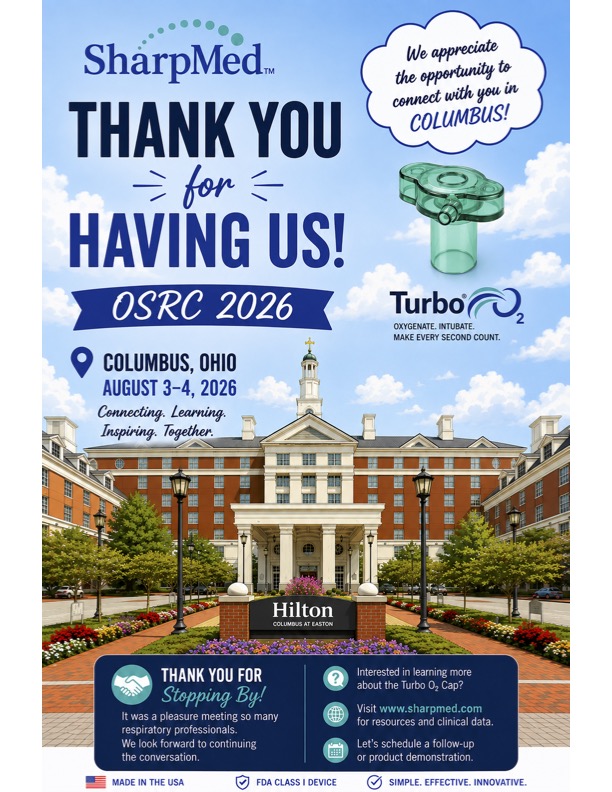
As part of this week’s update, SharpMed attended the Ohio Society for Respiratory Care (OSRC) Conference in Columbus, Ohio. The event brought together over 180 respiratory care professionals, including respiratory therapists, managers, directors, and health system leaders, along with 48 exhibitors showcasing the latest respiratory care technologies and solutions. The conference provided strong engagement with the Turbo O₂ Cap and resulted in several promising follow-up opportunities, including connections with Mount Carmel Health System, St. Anthony’s/Trinity Health, ProMedica Health (Toledo, OH), and other respiratory leaders across Ohio.
LinkedIn: https://www.linkedin.com/feed/update/urn:li:activity:7491181387023077376
Facebook: https://www.facebook.com/share/p/1Hc9YJZp9W/
We also continue to promote our SharpMed Live Series, held on the 1st and 3rd Thursdays of every month at 11:30 AM EST, where we share clinical insights, product education, and airway management discussions.
If you feel this content would be valuable to your customers or professional network, we’d appreciate your support by liking, commenting on, or sharing the posts with your connections.
Thank you for your continued support!
WATCH THE NATIONAL ASSOCIATION OF EMS PHYSICIANS’ WEBINAR
Dr. Chris Salvino recently presented at the National Association of EMS Physicians Webinar, sharing the research behind the Turbo® O₂ Cap and a progressive animal research program evaluating oxygenation during apnea and intubation.
The presentation follows the research from early proof-of-concept testing through extended-duration studies and a GLP animal model, examining what happens when 100% oxygen is delivered closer to the glottic inlet during an intubation attempt.
The research demonstrated:
• Without the device, oxygen saturation fell below 75% in less than one minute during control testing.
• With the Turbo® O₂ Cap delivering 15 L/min of 100% oxygen, saturation remained in the high 90s during initial 10-minute testing.
• Extended testing showed oxygen saturation at or above 94% for 15 minutes.
• Arterial blood gas findings further demonstrated sustained oxygenation during prolonged apnea in the animal model.
In this webinar, Dr. Salvino discusses the progression of the research, the physiology behind proximity oxygenation, and how the Turbo® O₂ Cap is designed to deliver oxygen proximal proximal to the glottic inlet during intubation.
WATCH THE FLORIDA EMS WEBINAR PRESENTATION
See the research, results, and discussion presented by Dr. Chris Salvino here.https://youtu.be/CJFY42Lehz4?si=oMNsQG8HxVtQrin7
Data discussed are from animal models and should be considered exploratory. Findings have not been directly validated as in clinical settings.
Join SharpMed’s Live Series session and add it directly to your calendar:
Occurs the First & Third Thursdays of every month at 11:30 AM EST
For more information, contact us at:
630-232-8002 x1 | orders@sharpmed.com
Preclinical Breakthrough in Airway ManagementTurbo® O₂ Cap Maintains Oxygen Saturation During Apnea
Discover how this oxygenation device for intubation maintained 99% saturation during apnea in a preclinical simulation.
Oxygen delivery during intubation has traditionally relied on methods that deliver oxygen from outside the airway. The Turbo® O₂ Cap takes a different approach by delivering oxygen toward the glottis through a standard endotracheal tube. This video provides a real-time comparison of oxygen saturation during apnea with and without the device in a controlled preclinical model.
🚫 Without the Turbo® O₂ Cap: oxygen fell below 75%
✅ With the Turbo® O₂ Cap: oxygen held at 99% for 10 minutes
The side-by-side demonstration illustrates the potential impact of proximity oxygenation during apnea and provides a visual complement to the growing body of preclinical research evaluating targeted airway oxygen delivery.
🎥 Watch the Real-time footage comparing endotracheal tube oxygen delivery with and without the device.
https://www.linkedin.com/feed/update/urn:li:activity:7485098948035014656
💡 Key Points
Provides oxygen delivery to the glottis
Designed for proximity oxygenation during RSI
Easy integration with standard ET tubes
Disclaimer:
Turbo® O₂ Cap is a patented device available for clinical use. Data shown are from animal models; not validated in humans.
Join SharpMed’s Live Series session and add it directly to your calendar:
https://lnkd.in/g-vDFbky
Occurs the First & Third Thursdays of every month at 11:30 AM EST
SharpMed is heading to Vienna! 🇦🇹
Our CEO, Dr. Chris Salvino, has been invited as a keynote speaker to participate in the International Congress on Pulmonology and Respiratory Diseases (PRD-2026), taking place July 21–22, 2026, in Vienna, Austria.
Day 2 – July 22, 2026
16:50–17:10 CET
Vienna, Austria
Dr. Salvino will present research from this preclinical animal series and discuss the work within the context of oxygenation and airway management.
We appreciate the opportunity to present this research and engage in scientific exchange with clinicians, researchers, and healthcare professionals from around the world.
We look forward to the conversations at PRD-2026.
#SharpMed#TurboO2Cap#PRD2026#Pulmonology#RespiratoryMedicine#AirwayManagement#PreclinicalResearch#MedicalDeviceResearch#MedTech

Most oxygenation strategies used during intubation begin at the nose – 14 cm from the vocal cords. This study explored what happens when oxygen delivery is repositioned much closer, near the actual glottic inlet.
Recently presented at the Canadian Association of Emergency Physicians in June of 2026, investigators evaluated the Turbo® O₂ Cap in a difficult-airway porcine model. The device attaches to a standard endotracheal tube and directs oxygen toward the glottic inlet during apnea. Twelve apneic intubation cycles were performed, comparing standard conditions with and without oxygen delivered through the device.
This highlights oxygen saturation trends and arterial blood gas measurements collected during 15-minute apnea periods, providing additional insight into oxygen delivery at the level of the vocal cords.
Join SharpMed’s Live Series session and add it directly to your calendar:
https://sharpmed.com/live-series/
Occurs the First & Third Thursday of every month at 11:30 AM ET
#AirwayManagement
#EMS
#CriticalCare
#TurboO2Cap
#PassiveOxygenation
#OxygenDelivery
#hypoxia
#difficultairwayintubations
#rapidsequenceinduction
#apneicoxygenation
#emergencyairway
#emergencyairwaymanagement

Presented at the California Society for Respiratory Care Conference
We recently presented at the California Society for Respiratory Care Conference (CSRC SoCal 2026) on a progressive animal series evaluating oxygen delivery at the level of the vocal cords during apnea.
The presentation reviewed sequential preclinical studies extending apnea duration from 10 to 16 minutes while maintaining oxygen saturation above 97% in test conditions. Control conditions consistently desaturated below 75% within approximately one minute.
The discussion also examined the physiologic limitations of traditional oxygen delivery during apnea and the concept of positioning oxygen directly near the laryngeal inlet during airway management.
Airway Oxygenation Brief (20-Min Clinical Discussions)
We are hosting short, clinician-led discussions focused on oxygenation during intubation – specifically where traditional approaches can fall short and how targeted airway oxygenation is being explored in practice.
These sessions are practical and discussion-based, bringing together perspectives from emergency, ICU, respiratory care, and EMS settings.
If interested, you can add an upcoming session directly to your calendar:
https://lnkd.in/g-vDFbky
Thursdays | 11:30 AM EST | 20 min | Join live
For more information, contact us at:
630-232-8002 x1 | orders@sharpmed.com

New Data – Oxygen Levels Maintained for 16 minutes During Apnea
Published in the American Journal of Emergency Medicine (February 2026), this proof-of-concept crossover study evaluated continuous oxygen delivery during simulated difficult intubation using a porcine model. Oxygen was delivered through an endotracheal tube positioned near the vocal cords during apnea.
In the control arm without oxygen delivery down the ET tube, cutaneous saturation declined below 75% within approximately one minute. In the test arm with oxygen delivery down the ET tube, cutaneous saturation remained at or above 97% for the full 16-minute apnea period across each cycle.
Arterial blood gas results showed sustained oxygen levels along with an expected increase in carbon dioxide, a moderate decrease in pH, and totally normal lactic acid after 16 minutes of prolonged apnea. These findings reflect physiologic changes consistent with apnea while maintaining oxygenation.
View the full study using this link.
https://lnkd.in/djjCPeHR
Airway Oxygenation Brief (20-Min Clinical Discussions)
We are hosting short, clinician-led discussions focused on oxygenation during intubation – specifically where traditional approaches can fall short and how targeted airway oxygenation is being explored in practice.
These sessions are practical and discussion-based, bringing together perspectives from emergency, ICU, respiratory care, and EMS settings.
If interested, you can add an upcoming session directly to your calendar: https://lnkd.in/g-vDFbky
Thursdays | 11:30 AM EST | 20 min | Join live
For more information, contact us at:
630-232-8002 x1 | orders@sharpmed.com
Most oxygen delivered at the nares during intubation never reaches the glottic inlet during apnea.
It’s something we’ve been discussing in short, 20-minute airway sessions with clinicians across ED, RT, and ICU settings.
The conversations are practical, candid, and focused on real-world application – not theory.
Add it to your calendar here:
https://lnkd.in/g-vDFbky
Thursdays | 11:30 AM EST | 20 min | Join live

From Dr. Chris Salvino: Arterial Blood Gas Data Presented at AzCEP Assembly
Presented as a poster at the AzCEP Annual Scientific Assembly, this study evaluates oxygenation during rapid sequence intubation under complete paralysis and no ventilation.
Across a structured large-animal series, serial arterial blood gases were obtained during prolonged apnea (up to 16 minutes). Under control conditions, oxygen saturation declined rapidly, falling below 75% in under one minute.
In contrast, when oxygen was delivered at the glottic inlet, arterial blood gas analysis demonstrated sustained oxygenation despite the absence of spontaneous respiration. Oxygen levels remained stable throughout the apnea period, while carbon dioxide increased gradually, consistent with expected physiologic patterns in non-ventilated states.
These findings emphasize the impact of oxygen delivery location. Conventional nasal oxygen delivery occurs at a distance from the vocal cords, whereas targeted delivery at the glottic inlet is reflected directly in arterial oxygenation measurements.
View
View the presentation using this link.https://sharpmed.com/wp-content/uploads/2026/04/AzCEP-Research-Symposium-Poster-Presentation-2026.pdf
Airway Oxygenation Brief (20-Min Clinical Discussions)
We are hosting short, clinician-led discussions focused on oxygenation during intubation – specifically where traditional approaches can fall short and how targeted airway oxygenation is being explored in practice.
These sessions are practical and discussion-based, bringing together perspectives from emergency, ICU, respiratory care, and EMS settings.
If interested, you can add an upcoming session directly to your calendar: https://sharpmed.com/live-series/
Thursdays | 11:30 AM EST | 20 min | Join live
For more information, contact us at:
630-232-8002 x1 | orders@sharpmed.com
Houston Shock Symposium: 15 Minutes of Apneic Oxygenation
We are sharing results from our research presented at the Houston Shock Symposium examining prolonged apneic oxygenation using the Turbo® O₂ Cap.
Summary
Titled “Apneic Oxygenation for Fifteen Minutes Achieved Using a Commercial Device in a Paralyzed Porcine Model,” this study evaluated the physiologic impact of targeted, glottic level oxygen delivery during simulated difficult intubation under paralysis.
In a large animal rapid sequence intubation model, test cycles using the Turbo® O₂ Cap sustained oxygen saturation ≥94% for the full 15-minute apnea period, while control cycles without oxygen delivery desaturated below 75% within one minute (Fisher’s exact p = 0.0022). Arterial blood gas data demonstrated sustained PaO₂ throughout apnea, modest PaCO₂ elevation, and pH remaining near 7.2 without the need for intervention. The endotracheal tube was intentionally positioned to the side of the vocal cords to simulate a difficult airway, and no reoxygenation or bag mask ventilation was required during test cycles.
View
View the presentation using this link.
Context
This presentation complements a recent peer-reviewed publication in BMC Anesthesiology, further supporting proximity oxygenation as a differentiated strategy for extending the safe apnea window during intubation.
Join the Weekly Live Discussion (Zoom)
For a full clinical overview and continued discussion, we invite you to attend our Turbo® O₂ Cap Live Series. View upcoming sessions and add them directly to your calendar at:
https://lnkd.in/g-vDFbky
For more information, contact us at:
630-232-8002 x1 | orders@sharpmed.com
We recently put together a short educational video called “The 14 cm Problem.”
During apneic oxygenation, nasal cannulas deliver oxygen at the nares, but the oxygen still has to travel ~14 cm to reach the vocal cords, and much of it disperses before reaching the airway.
The video demonstrates how quickly oxygen concentration drops just centimeters from the cannula tip and why studies on nasal cannula apneic oxygenation have shown mixed results in the ED and ICU.
It also shows an alternative approach: delivering oxygen directly at the vocal cords through the ET tube using the Turbo® O₂ Cap.
Watch the video demonstration here:
If you’re interested, we host a short live airway discussion every Thursday evening.
Thursday | 6:30 PM ET
You can add this to your calendar via the link below.
https://sharpmed.com/live-series/
Would enjoy hearing your thoughts.
Regards,
Anthony Escandon
VP of Sales & Marketing
SharpMed, LLC
Mobile: 480.776.9185
Schedule Update – SharpMed Live Series

Please note a change to our Live Series schedule. Beginning February 26, sessions will now be held: Thursdays at 6:30 PM ET
Kindly update your calendar to reflect the new time so you don’t miss an upcoming session.
We’ll continue exploring oxygen delivery during intubation through live demonstrations, clinical insights, and interactive Q&A.
We look forward to seeing you Thursday at 6:30 PM ET.
Turbo® O₂ Cap Live Series

A live virtual series exploring a new approach to oxygenation during intubation and why distance matters more than we think. Nasal cannula oxygen is delivered at the nares, and the effective oxygen concentration can diminish as it travels toward the glottic inlet – a limitation often referred to as the 14 cm problem. In this series, we’ll take a first look at how the Turbo® O₂ Cap addresses this gap by turning any standard endotracheal tube into the first-ever high-flow ET tube, providing oxygen where it matters most, at the glottic inlet. Join us for short demonstrations, clinical insights, and open Q&A as we explore a new direction in airway management when seconds matter most.
What is your opinion of the nasal cannula as an adjunct during intubation?
This Week’s Social Post

Hi Team,
This week’s post asks:
What is your opinion of the nasal cannula as an adjunct during intubation?
Most clinicians rely on nasal cannulas for preoxygenation and apneic oxygenation, but don’t realize how quickly oxygen concentration drops just a few centimeters from the tip—meaning very little may reach the vocal cords. This helps explain mixed results in ED and ICU studies.
Please engage and share:
Facebook: https://www.facebook.com/share/v/1FaCWx1HuH/
LinkedIn: https://www.linkedin.com/feed/update/urn:li:activity:7402393059700965376
This week’s video is also saved in Dropbox for your use in presentations or customer outreach:
Dropbox link: https://www.dropbox.com/scl/fi/gd22l73agls0mf8svxpvb/The-14-CM-Problem-Short-Video-for-Social-Media-112525.mp4?rlkey=0x98i12pobtvri7dle6dav1au&st=adbeiew8&dl=0
A quick like, share, or comment goes a long way. Thanks for helping drive engagement this week!
This Week’s Social Media Post – ITLS Conference
ITLS Conference
Hi Team,
We’ve posted our ITLS conference appreciation message this week.
Please feel free to view and share the post on your channels:
Facebook: https://www.facebook.com/share/v/1BU3vCF26Q/
LinkedIn:https://www.linkedin.com/feed/update/urn:li:activity:7397349716813901825
Thank you for your continued support and representation of SharpMed.
Holiday Operations Update
Holiday Schedule – December 2025

SharpMed will be operating with limited support during the holidays.
For urgent inquiries, please contact your assigned account representative.
New Feature Release
New Dashboard for ISR members Added!

We’ve added a new module that lets you view, download, and manage Sharpmed updates faster.